Goal: Understand Sturm–Liouville problems, eigenvalues, orthogonality, and eigenfunction expansions.
1. Sturm–Liouville Problems
Definition: A Sturm–Liouville problem is an endpoint value problem of the form
together with boundary conditions
where neither \( \alpha_1, \alpha_2 \) both zero nor \( \beta_1, \beta_2 \) both zero. The parameter \( \lambda \) is the eigenvalue, whose allowable constant values are sought.
These problems are named after the French mathematicians Charles Sturm and Joseph Liouville, who investigated such problems in the 1830s.
Note that a Sturm–Liouville problem always has the trivial solution \( y(x) \equiv 0 \). We seek values of \( \lambda \), called eigenvalues, for which the problem admits a nontrivial real-valued solution \( y(x) \not\equiv 0 \). Such a solution is called an eigenfunction corresponding to \( \lambda \).
Example 1.1. We obtain different Sturm–Liouville problems by pairing the same differential equation
with different homogeneous endpoint conditions:
- \( y(0) = y(L) = 0 \)
- \( y'(0) = y(L) = 0 \)
- \( y(0) = y'(L) = 0 \)
- \( y'(0) = y'(L) = 0 \)
2. Sturm–Liouville Eigenvalues
Theorem 1 (Sturm–Liouville Eigenvalues): Suppose the functions \( p(x), p'(x), q(x), r(x) \) are continuous on the interval \( [a,b] \), and that
Then the eigenvalues of the Sturm–Liouville problem form an increasing sequence of real numbers
and satisfy
Furthermore, to within a constant multiple, there is exactly one eigenfunction \( y_n(x) \) associated with each eigenvalue \( \lambda_n \). In addition, if \( q(x) \ge 0 \) on \( [a,b] \) and the coefficients \(\alpha_1,\alpha_2,\beta_1,\beta_2\) are nonnegative, then all eigenvalues are nonnegative.
A Sturm–Liouville problem is called regular if it satisfies the hypotheses of Theorem 1, that is, it is regular if the following conditions hold:
- The interval \([a,b]\) is finite (that is, \( -\infty < a < b < \infty \)).
- The functions \( p(x), p'(x), q(x), r(x) \) are continuous on \( [a,b] \).
- \( p(x) > 0 \) and \( r(x) > 0 \) on \( [a,b] \).
If any of these conditions fail, the Sturm–Liouville problem is classified as singular.
Example 2.1. Consider the Sturm–Liouville problem
Solving this problem leads to three cases \( \lambda < 0 \), \( \lambda = 0 \), and \( \lambda > 0 \). Only the positive case produces nontrivial solutions. The eigenvalues are
and the corresponding eigenfunctions are
Here we identify \( p(x) = 1 \), \( r(x) = 1 \), \( q(x) = 0 \), and boundary coefficients \( \alpha_1 = \beta_1 = 1 \), \( \alpha_2 = \beta_2 = 0 \). Thus, by Theorem 1, all eigenvalues are nonnegative.
Example 2.2. Find the eigenvalues and associated eigenfunctions of the Sturm–Liouville problem
Solution: This problem satisfies the hypotheses of Theorem 1 with \( \alpha_1 = 1 \), \( \alpha_2 = 0 \), \( \beta_1 = h > 0 \), and \( \beta_2 = 1 \). Hence there are no negative eigenvalues.
First consider \( \lambda = 0 \). Then the differential equation becomes
Applying \( y(0) = 0 \) gives \( B = 0 \), so \( y(x) = Ax \). Applying the second boundary condition:
Since \( h > 0 \), this forces \( A = 0 \), so only the trivial solution exists. Therefore, \( \lambda = 0 \) is not an eigenvalue.
For \( \lambda > 0 \), write \( \lambda = \mu^2 \). Then
Applying \( y(0) = 0 \) gives \( A = 0 \), so
Applying the second boundary condition:
For nontrivial solutions \( B \neq 0 \), we have
Remark: If \( \cos(\mu L) = 0 \), then
Substituting into the boundary condition
which contradicts \( h > 0 \). Therefore,
We divide by \( \cos(\mu L) \) (nonzero) to obtain
Let \( x = \mu L \). Then this becomes
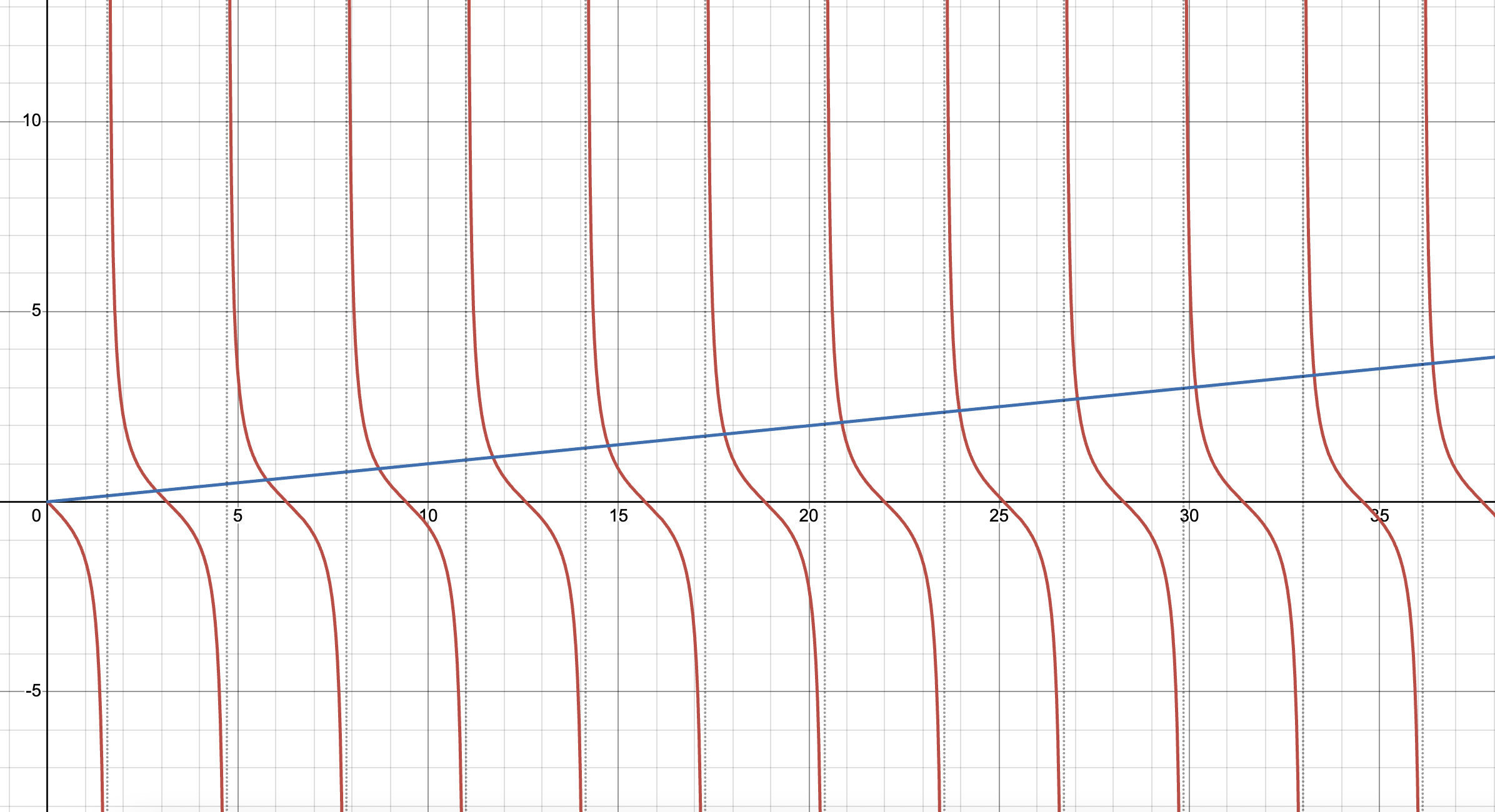
The solutions \( x = \mu L \) of this equation are the points of intersection of the graphs \( y(x) = -\tan x \) and \( y(x) = x/(hL) \). From the graph, there is an infinite sequence of positive roots
and for large \( n \), \( \beta_n \) is close to \( \frac{(2n-1)\pi}{2} \). The eigenvalues and eigenfunctions are
3. Orthogonal Eigenfunctions
Two functions \( \phi(x) \) and \( \psi(x) \) are said to be orthogonal on the interval \( [a,b] \) with respect to the weight function \( r(x) \) if
The following theorem shows that any two eigenfunctions of a regular Sturm–Liouville problem corresponding to distinct eigenvalues are orthogonal with respect to the weight function \( r(x) \).
Theorem 2 (Orthogonality of Eigenfunctions):
If the Sturm–Liouville problem is regular, then any two eigenfunctions corresponding to distinct eigenvalues are orthogonal with respect to the weight function \( r(x) \); that is,
Example 3.1. Consider the Sturm–Liouville problem
Eigenvalues and Eigenfunctions:
The eigenvalues are
The corresponding eigenfunctions are
Orthogonality:
These eigenfunctions are orthogonal on \( [0,\pi] \), since
4. Eigenfunction Expansions
Theorem 3 (Eigenfunction Expansion / Completeness):
Let \( \{y_n(x)\} \) be the eigenfunctions of a regular Sturm–Liouville problem. Then any piecewise smooth function \( f(x) \) on \( [a,b] \) can be represented as a generalized Fourier series:
The coefficients are given by
To determine the coefficients \( c_1, c_2, c_3, \dots \), we generalize the technique used to find ordinary Fourier coefficients in Section 9.1. First, we multiply both sides of the expansion by \( y_m(x)\,r(x) \) and integrate over the interval \( [a,b] \):
Using the orthogonality of the eigenfunctions, all terms vanish except when \( n = m \), which allows us to isolate \( c_m \).
Example 4.1. Represent the function \( f(x) = 9x \) as a series of eigenfunctions of the Sturm–Liouville problem
The eigenvalues and eigenfunctions are given by
Solution:
We expand \( f(x) = 9x \) in terms of the eigenfunctions:
where
First compute the numerator:
Use integration by parts:
Apply the formula \( \int u\,dv = uv - \int v\,du \):
Evaluate the boundary term:
Compute the remaining integral:
Substitute back:
Simplify:
Using the boundary condition
we obtain
Hence the numerator becomes
Next compute the denominator:
Therefore,
5. Other examples
Example 5.1: Find the eigenvalue/eigenfunction pair corresponding to the smallest eigenvalue for the Sturm–Liouville problem
- \( y_0=\sinh(kx) \) and \( \lambda_0=-k^2 \) where \( k \) is the smallest solution to \( \tanh(3\pi k)=k \) (Correct)
- \( y_0=\cosh(kx) \) and \( \lambda_0=-k^2 \) where \( k \) is the smallest solution to \( \tanh(3\pi k)=k \)
- \( y_0=1 \) and \( \lambda_0=0 \)
- \( y_0=\sin(kx) \) and \( \lambda_0=k^2 \) where \( k \) is the smallest solution to \( \tan(3\pi k)=k \)
- \( y_0=\cos(kx) \) and \( \lambda_0=k^2 \) where \( k \) is the smallest solution to \( \tan(3\pi k)=k \)
Solution:
For the smallest eigenvalue, set \( \lambda = -k^2 \), \( k>0 \). Then
The general solution is
Apply \( y(0)=0 \):
Apply \( y(3\pi)-y'(3\pi)=0 \):
Hence
Since the equation \( \tanh(3\pi k)=k \) has exactly one positive solution, denote it by \( k_0 \). Hence the eigenvalue is
The eigenfunction is
Final eigenpair:
The Sturm–Liouville problem
has eigenvalues \( \lambda_n=\beta_n^2 \), where \( \beta_n \) are the positive solutions of \( \tan(\beta)=-\beta \), such that \( \beta_1 < \beta_2 < \cdots \), and eigenfunctions \( y_n=\sin(\beta_n x) \), which are mutually orthogonal. If the function \( f(x)=1 \) is expanded using these eigenfunctions,
find \( c_n \).
Choose the correct answer:
- \( c_n=\dfrac{4-4\cos(\beta_n)}{2\beta_n-\sin(2\beta_n)} \)
- \( c_n=\dfrac{4-4\sin(\beta_n)}{2\beta_n-\cos(2\beta_n)} \)
- \( c_n=\tan(4\beta_n) \)
- \( c_n=\tan(2\beta_n) \)
- \( c_n=\tan(\beta_n) \)
We expand \( f(x)=1 \) in terms of the eigenfunctions:
The coefficients are given by orthogonality:
Numerator:
Denominator:
Combine:
Final answer:
Correct answer: A